Inquiry
Form loading...
Industrial joints rarely fail because a bolt looked unimpressive on a shelf. They fail when load, material, installation, and environment do not match. Machine Bolts therefore deserve more attention than a simple diameter-and-length comparison. A hex-head bolt may suit a serviceable frame, while a socket-head bolt can fit a compact assembly. Flange designs can spread bearing pressure, but they are not automatically right for every joint.
Fastener engineer Richard T. Barrett, author of NASA’s Fastener Design Manual, is a useful technical reference for understanding bolted-joint design. A paraphrased takeaway from his engineering guidance is: “Choose a fastener for the joint’s loads and conditions, not appearance alone.” This is a summary, not a verbatim quotation. It points to the questions that matter: What tensile and shear loads will the joint carry? Will vibration loosen it? Could moisture or chemicals attack the bolt? Is the specified grade compatible with the mating parts?
Small details count. A bright zinc finish may look clean, yet perform poorly in a harsh environment. A high-strength bolt may also be a poor choice if the joint design or tightening method is unsuitable. No single bolt wins. This guide compares common machine-bolt types, materials, grades, and finishes for industrial work. It also explains what to check before selection and installation. Specifications help, but they do not replace engineering judgment; real assemblies can behave differently than expected.
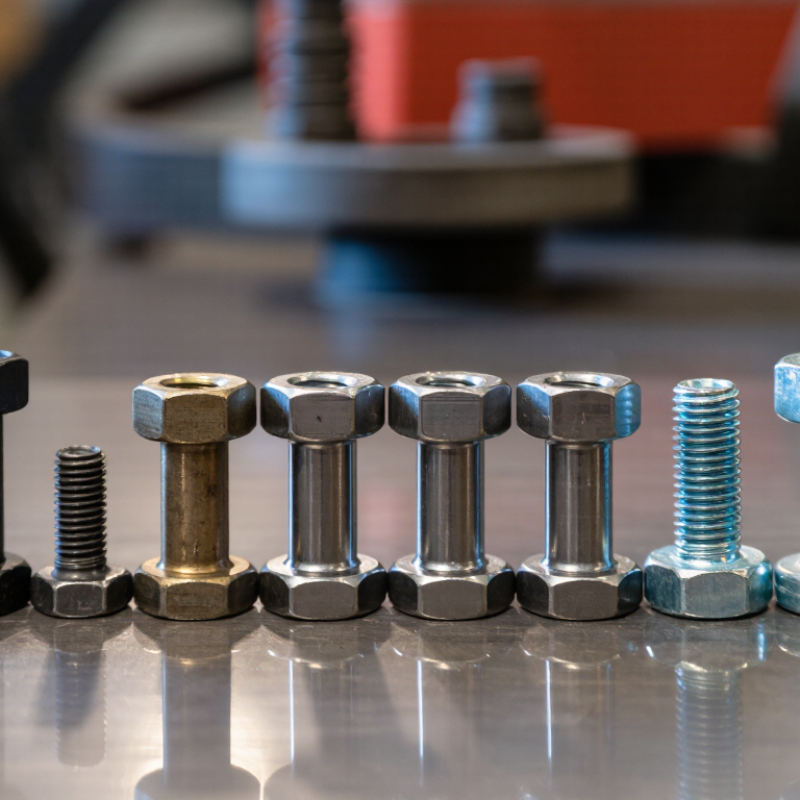
Machine bolts are threaded fasteners designed to clamp machine parts together. A typical bolt has a head, an unthreaded shank, and a threaded end that engages a nut or tapped hole. Tightening stretches the bolt slightly, creating preload that presses the connected surfaces together. The joint then resists movement through friction and the bolt’s ability to carry tension or shear. Fit matters: a loose hole can let parts shift before the bolt bears against its edge. Small details count.
Torque is commonly used to create preload, but it does not measure bolt stretch directly. NASA’s Fastener Design Manual, RP-1228, describes torque-based preload as sensitive to friction; typical accuracy may be around ±25%, depending on conditions and procedure. Lubrication, surface finish, and thread condition can all change the result. That estimate is not a universal guarantee. In industrial maintenance, technicians should follow the specified bolt grade, tightening sequence, and torque procedure, especially when several bolts clamp a rigid flange. A calibrated wrench helps, but it cannot correct a wrong specification. I have seen this overlooked: a bolt can feel tight while the joint still lacks even clamping force. The manual’s key lesson is practical—torque is useful, yet preload remains an estimate unless the assembly method controls friction and verifies tension.
| Bolt Type | How It Works | Common Materials or Grades | Typical Industrial Uses | Key Selection Considerations |
|---|---|---|---|---|
| Hex-head machine bolt | A threaded shank passes through aligned clearance holes and is usually secured with a nut. The hexagonal head allows tightening with a wrench or socket. | Carbon steel, alloy steel, or stainless steel; metric property classes such as 8.8 and 10.9 are common for steel fasteners. | Equipment frames, brackets, machinery housings, and general structural assemblies. | Match the bolt diameter, length, thread pitch, strength class, and corrosion resistance to the joint design and service conditions. |
| Socket-head cap screw | A cylindrical head with an internal hex drive is tightened with a hex key or socket. It is commonly used where a compact head or recessed installation is needed. | Alloy steel is common; stainless-steel versions are available. Strength and material specifications vary by standard and product. | Machine tools, compact assemblies, fixtures, and equipment with limited wrench clearance. | Check head clearance, drive access, thread engagement, and whether the design calls for a screw threaded into a tapped hole rather than a nut. |
| Flange-head bolt | An integrated flange spreads bearing pressure beneath the head and can reduce the need for a separate washer in suitable applications. | Carbon steel, alloy steel, and stainless steel; available in different strength classes and finishes. | Machinery panels, equipment mounts, and assemblies where a wider bearing surface is useful. | Confirm the flange diameter and bearing surface are compatible with the material being clamped; a flange does not replace every washer or locking method. |
| Structural hex bolt | A high-strength bolt clamps structural steel components, typically as part of an engineered bolted connection. | Structural grades specified under standards such as ASTM F3125, which includes grades such as A325 and A490. | Steel structures, industrial platforms, and heavy-duty support frames. | Use the grade, installation method, hole configuration, and connection design required by the applicable structural specification. |
| Stainless-steel hex bolt | Functions like a standard hex-head bolt while providing improved corrosion resistance in suitable environments. | Common stainless fastener designations include A2 and A4 under ISO 3506; exact property class and grade matter. | Food-processing equipment, outdoor machinery, and installations exposed to moisture or some corrosive conditions. | Stainless steel is not immune to corrosion. Consider the specific chemicals, temperature, crevice conditions, strength needs, and risk of galling. |
| Anchor bolt | Secures equipment or structural members to concrete or masonry through an embedded end or a designed anchoring system. | Carbon steel and stainless steel; the appropriate specification depends on the anchoring system and environment. | Machine bases, equipment foundations, columns, and support frames attached to concrete. | Select the anchor type and embedment for the substrate, loads, edge distances, installation method, and applicable building or engineering requirements. |
Selection note: “Machine bolt” is commonly used for a bolt with a head and threaded shank that fastens parts, often with a nut, but terminology can vary by industry and region. Always verify the governing standard, dimensions, material, strength rating, and installation requirements for the specific application.